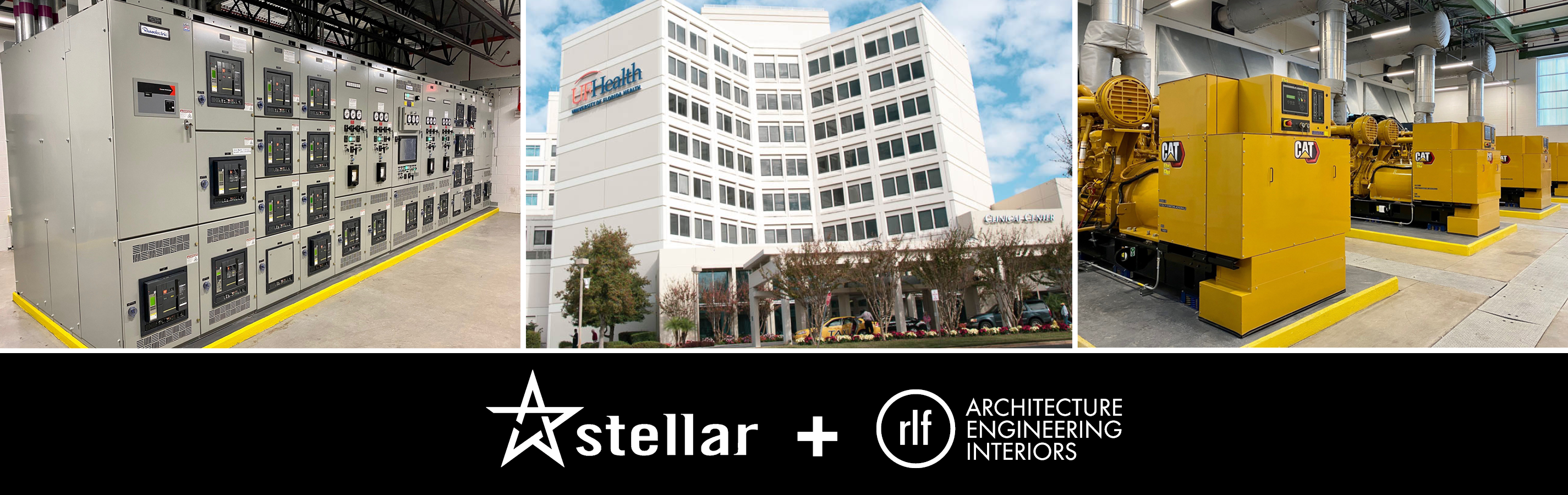
In healthcare, infrastructure failures are not an inconvenience. They are a risk. Hospitals are often asked to modernize aging systems while staying fully operational, compliant, and ready for the unexpected.
At UF Health Jacksonville, The Stellar Group and RLF partnered as a design-build team to modernize outdated electrical distribution systems while the hospital remained fully operational.
The modernization included replacement of emergency generators, paralleling switchgear, automatic transfer switches, and utility services, including the main distribution switchgear, sub distribution switchboards, and motor control centers. Every phase required careful coordination, real-time problem solving, and clear accountability to protect patient care. The hospital never stopped operating. Patients continued to arrive. Clinical staff relied on critical systems around the clock. Any disruption to normal or emergency power would have directly affected care.
Upgrades were completed in fully occupied spaces, often with limited documentation and strict regulatory requirements. The design-build delivery model allowed the team to align early, make informed decisions quickly, and respond to actual field conditions as they were uncovered.
From the start, patient care guided every decision. Designs were verified on site and adjusted as needed. System transitions were carefully phased to keep equipment energized at all times. Construction schedules were coordinated around clinical operations to minimize disruption for patients and staff.
The design team created a detailed sequence of construction that outlined each step of the work to minimize operational disruptions during construction. Every transition was mapped out in advance so electrical systems could remain online and patient care would not be interrupted.
Detailed temporary conditions plans were developed as well. In a hospital environment, temporary solutions can be just as important as permanent installations. Interim power feeds, temporary life-safety measures, and phased system tie-ins were carefully planned to maintain reliability throughout construction.
The design also included a custom testing sequence to simulate real-world failure scenarios. Equipment was tested under conditions that mirrored potential utility outages and system failures to confirm performance before final turnover. This process demonstrated that the systems performed exactly as intended and provided confidence that the hospital could rely on them without hesitation.
These measures reinforced a core principle of the project, modernization in healthcare cannot rely on assumptions. It requires verification, planning, and a disciplined approach to risk management. By addressing both permanent infrastructure and temporary conditions with equal rigor, the team ensured continuity of care remained protected at every stage of construction.
The focus was not only on completing the work, but on delivering long-term value. Modern, energy-efficient, resilient power infrastructure was implemented to support future technologies and continued growth, all while maintaining continuous operations.
When the COVID-19 pandemic introduced new challenges, flexibility became essential. Supply chain disruptions, workforce constraints, and evolving safety protocols required constant adjustment. The design-build approach allowed the team to adapt while keeping safety and continuity of care at the center of every decision.
The work at UF Health reflects what design-build means in an active healthcare environment. It is not about speed. It is about accountability. It is about one team taking responsibility for outcomes that directly support patient care.
Hospitals do not have an off switch. The engineering behind them must be built with that reality in mind.